Sole Trader vs Company in New Zealand
Deciding whether to run your business as a sole trader or a company can feel tricky because both have positives and negatives. Every business is different, so the best choice depends on things like how big you want your business to grow, how you’ll handle taxes, and how you plan to run it day-to-day.
Many people start as sole traders because it’s simpler and more straightforward. However, as their business grows and they begin to earn more, they often start considering the potential benefits of switching to a company structure, especially when it comes to taxes.
One big difference between sole trader vs company is how they deal with taxes. The way each is taxed can change how much money your business keeps. In this blog, we’ll look at the good and bad sides of being a sole trader or running a company. We’ll also talk about how the tax rules work for each and what this means in New Zealand.
What is a Sole Trader?
A sole trader is someone who runs their own business by themselves. They are in charge of everything, like managing daily tasks and making big decisions for the future. Being a sole trader means you have full control, but it also has risks. There’s no difference between you and your business in the eyes of the law. This means if your business owes money or gets into trouble, you might have to use your own things, like your house or savings, to fix it.
A sole trader is the simplest business structure in New Zealand.
Under NZ tax law, a sole trader is not legally separate from the individual who owns the business. This means:
- The business income is treated as personal income
- You report your earnings in your IR3 individual tax return
- You pay tax at individual marginal tax rates (up to 39%)
Key Features
- No separate legal entity
- Easy and low cost to set up
- Minimal compliance requirements
- Full control over decisions
Tax Treatment
All profits are taxed in your own name.
You can also claim business expenses directly against your income.
Things to Consider
- You are personally liable for all debts
- Higher income can push you into higher tax brackets
- Less flexibility for tax planning
What is a Company?
A company is a separate legal entity under the Companies Act 1993.
This means the business exists independently from its owners (shareholders) and is taxed separately under NZ tax law.
Key Features
- Separate legal identity
- Owned by shareholders
- Managed by directors
- Requires registration with the Companies Office
Tax Treatment
- Companies pay tax at a flat rate of 28%
- Income is taxed in the company first
- Owners pay tax when income is:
- Distributed as dividends, or
- Paid as salary/wages
Things to Consider
- More compliance (annual returns, financial statements)
- More structure and administration
- Greater flexibility in managing income and tax
- Limited liability (in most cases)
Key Differences Under NZ Tax Law
|
Feature |
Sole Trader |
Company |
|
Legal Status |
Same as owner |
Separate entity |
|
Tax Return |
IR3 (individual) |
IR4 (company) |
|
Tax Rates |
Up to 39% |
28% |
|
Liability |
Personal liability |
Limited liability |
|
Complexity |
Simple |
More complex |
|
Profit Use |
Personal income |
Can retain or distribute |
Which One is Right for You?
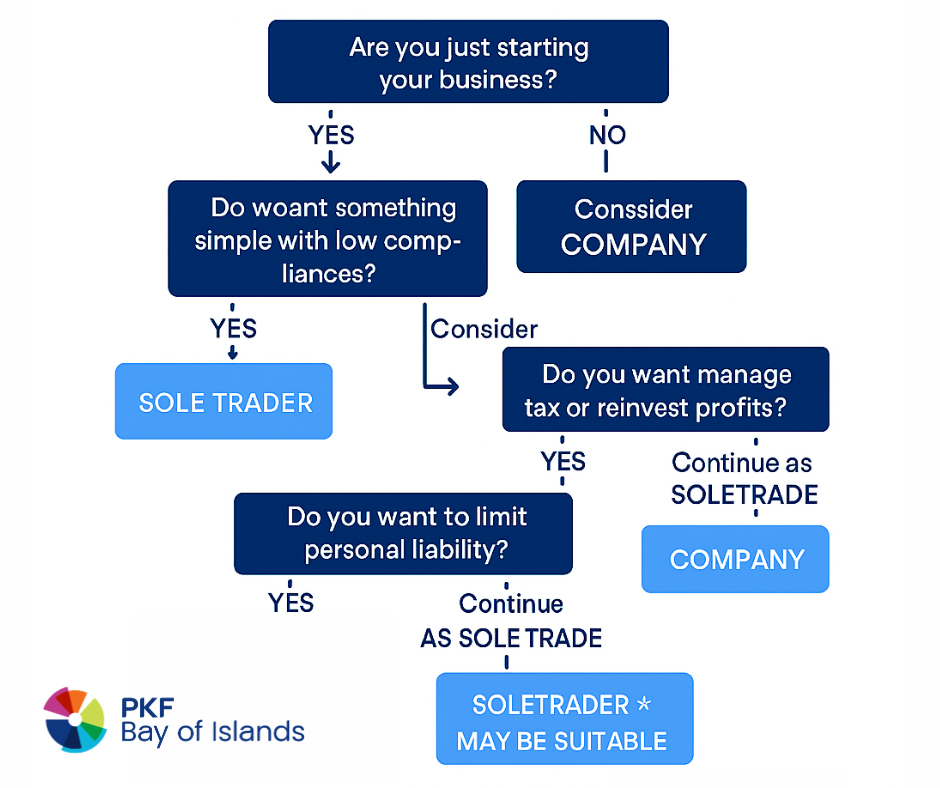
There is no one-size-fits-all answer — it depends on your situation.
Sole Trader may suit if:
- You are just starting out
- Your income is relatively low
- You want simplicity and low costs
Company may suit if:
- Your business is growing
- You want to manage or reinvest profits
- You want separation between personal and business risk
You are earning at higher tax rates
Insurance Considerations (NZ)
Sole Trader
You are personally responsible, so insurance is important.
ACC covers injuries, but not full income replacement
Consider:
· Income protection insurance
· Public liability insurance
· Professional indemnity
Your personal assets may be at risk without cover.
Company
· Even with limited liability, insurance is still needed:
· ACC applies to employees and shareholders
· Business insurance still required
· Consider Directors & Officers insurance
A company reduces risk — but does not eliminate it.
Access to Business Funds
Sole Trader
· Can take money out anytime (drawings)
· Business income = personal income
· Separate bank account recommended
Flexible and simple
Company
Must use company bank account
· Cannot take drawings freely
· Paid via:
· Salary/wages
· Shareholder salary
· Dividends
More structured and controlled
Ongoing Operating Costs (NZ)
Sole Trader
· Low costs
· No ongoing registration fees
· May need GST registration ($60,000 threshold)
· Mainly accounting and compliance costs
Company
· Annual Companies Office fee (~$45)
· Company tax return (IR4)
· Higher accounting and compliance costs
More cost, but supports growth and structure
When Should You Move to a Company?
You may consider transitioning when:
Your risk is increasing
A company can protect your personal assets.
You want to grow or raise capital
Companies can bring in investors and shareholders.
Your income is increasing
At higher income levels, companies offer tax planning opportunities.
You want long-term continuity
Companies can continue beyond the owner and are easier to sell.
Final Thoughts
Choosing between a sole trader and a company isn’t just about tax, it’s about:
- Risk
- Growth plans
- Cashflow
- Long-term strategy
Getting the structure right early can save you time, money, and stress as your business grows.
Need Help Deciding?
If you’re unsure which structure is right for you, the team at PKF Bay of Islands can help you make the right decision based on your goals and circumstances.
Complete the flow chart below to see which business structure may suit you best. If you’re still unsure, feel free to reach out — we’re here to help.